
— ✦ —
Marketing Strategy · Print ROI
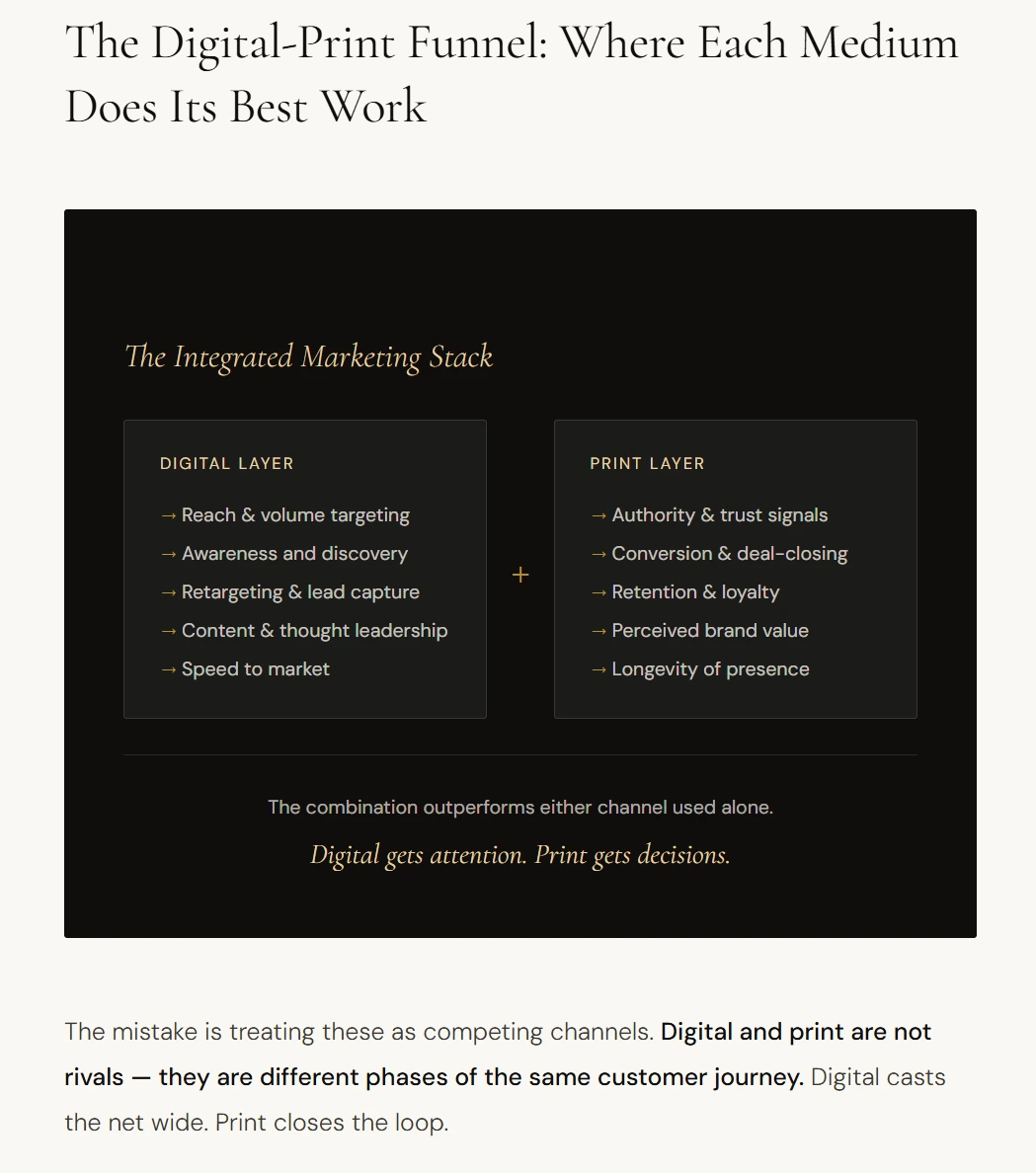
There is a pattern that repeats itself across high-performing marketing teams — in enterprise sales, in luxury retail, in B2B services. They use digital to generate awareness and interest. Then they use physical print to convert and retain.
Yet the attribution models, the dashboards, and most of the marketing conversation focuses entirely on the digital half of that equation. Print rarely gets credit. But print is often where the deal is actually made.
The Numbers Worth Knowing
Before getting into strategy, the data deserves a moment. These figures come from sources that measure actual marketing outcomes — not reach or impressions, but responses, trust, and perceived value.
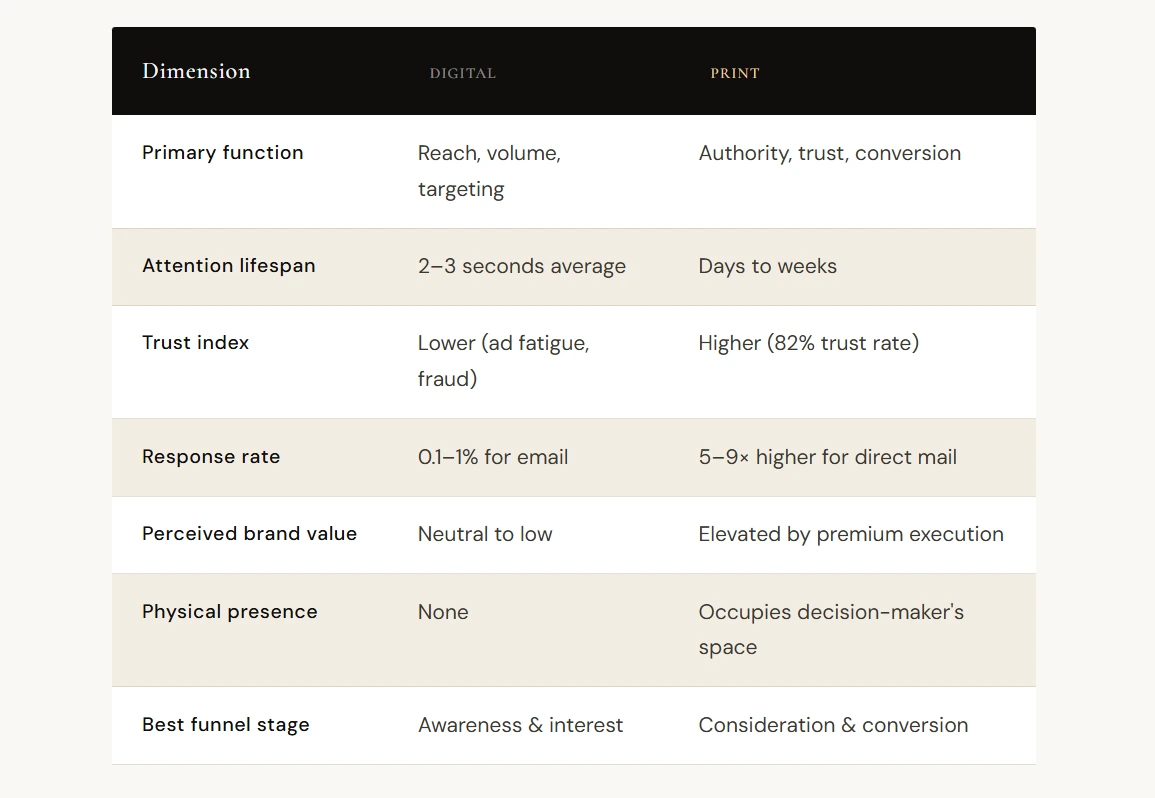
5–9×higher response rate for direct mail vs. emailData & Marketing Association
82%of consumers trust print ads more than digital adsMarketingSherpa
70%of people feel print is more personal than online communicationCanada Post / True Impact
Luxury brands report it consistently: print catalogues outperform digital lookbooks in perceived product value. A physical mailer generates higher brand recall than a retargeted banner ad running for the same period. The medium is the message — and print sends a message that digital cannot replicate.
"A brochure sitting on a decision-maker's desk stays there for weeks. A digital ad disappears in three seconds."
The fundamental asymmetry of attention
Why Print Works Differently
The reason is rooted in how human attention processes physical vs. digital stimuli. Digital media is experienced in a state of constant scanning — the eye trained to skip, scroll, and filter. Print demands a different posture. It is held. It is touched. It occupies physical space in the environment.
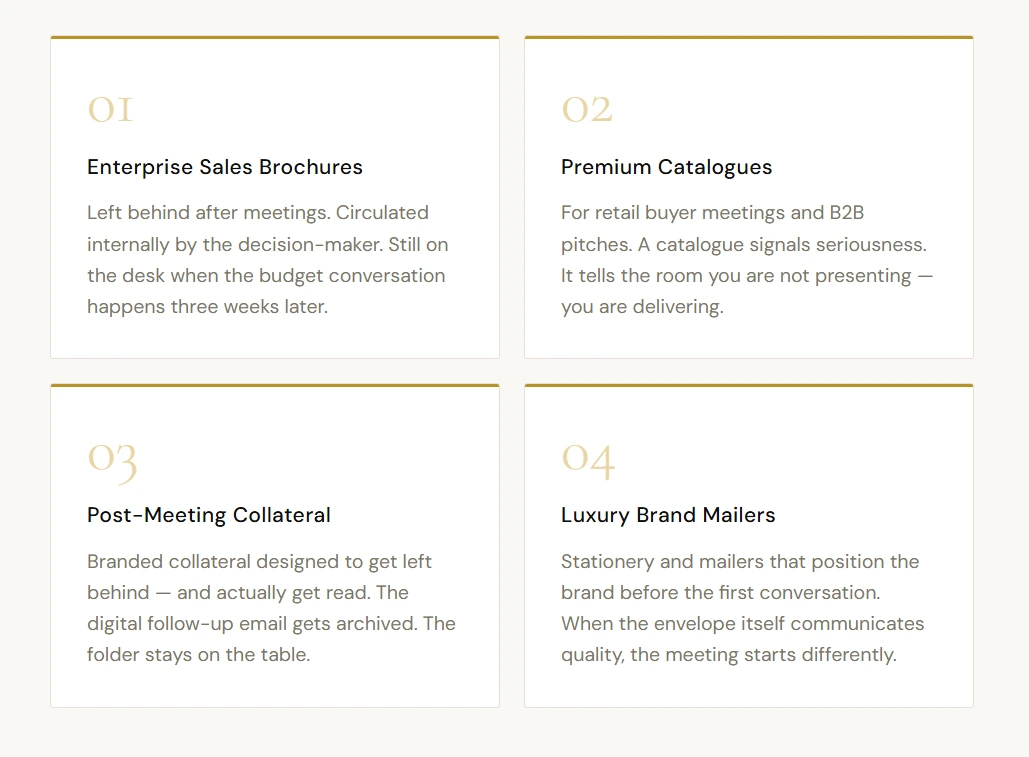
A premium catalogue left in a boardroom does not just sit there — it works. Every time someone picks it up, turns a page, or leaves it visible during a meeting, it is doing marketing. There is no equivalent of that in digital. You cannot retarget someone with a pixel three weeks after they've left the room. But the brochure can.
This is not nostalgia. This is physics and psychology working in your favour — but only if the print material is designed and produced at a standard that commands that kind of attention.
Where Smart Teams Are Using Print Right Now
The Comparison That Changes How You Budget
The Execution Principle
One caveat that cannot be overstated: print only performs when it is produced at a standard that matches the brand promise.
A poorly printed, thin-paper brochure does not leave the impression described above it does the opposite. It signals that the brand cuts corners. The same design, printed on the right substrate with the right finish, communicates an entirely different story before a single word is read.
This is the point where the medium becomes the message. When a prospect picks up a matte-laminated catalogue with spot UV on the cover, they make a subconscious judgment about the company that produced it. That judgment precedes any rational evaluation of the content inside. Premium print is brand positioning delivered in physical form.
The marketing budget allocation question is not "print or digital." It is: at what stage of the customer journey is print the highest-leverage tool? For most brands operating at a premium positioning that answer is at the conversion and retention stages, every time.
The brands that have never dropped print from their marketing mix are not being nostalgic. They are being precise about which medium produces which outcome. If your marketing stack has zero print touchpoints, you are leaving trust and conversion on the table.